Cloud security threats, risks and vulnerabilities in 2026

First, what’s the difference between the three? Cloud security threats are harmful events or actions that can affect cloud systems, such as hacked accounts, phishing, data theft, or ransomware. Vulnerabilities are the weak points that make those attacks easier, and risks are the possible business consequences, such as downtime, fines, or loss of customer trust.
Main cloud security threats include misconfigurations, poor authentication controls, account hijacking, insecure APIs, external data breaches, insider threats, data loss, denial-of-service attacks, shadow IT, AI-powered attacks, supply chain attacks, and ransomware targeting cloud storage.
This article explains the main cloud security risks, threats, and vulnerabilities, with practical steps to reduce them.
How secure is the cloud?
Questions about cloud security threats are a valid concern, as, in public cloud environments, sensitive data is usually stored in provider-managed infrastructure. However, in most cases, data will be much safer when stored in the cloud than kept on the user’s device.
Usually, cloud data is stored in an encrypted form, meaning that anyone needing data access needs a digital key. Not to mention that the data itself is stored across many servers. This is done to protect the information in case of a server malfunction or a cyberattack.
Cloud security risks vs. threats vs. vulnerabilities
Cloud security risks, threats, and vulnerabilities are connected, but different. Separating these terms helps teams decide what to fix first: reduce vulnerabilities, monitor threats, and lower business risk.
A cloud security threat is a possible harmful event or action, such as a hacker stealing login details, a phishing email tricking an employee, or ransomware locking cloud files.
A vulnerability is a weakness that makes the threat easier to carry out, such as a public storage bucket, weak password rules, missing multi-factor authentication (MFA), or an unpatched application.
A risk is the potential business impact if the threat uses that weakness, such as data loss, service downtime, regulatory fines, or lost customer trust.
For example, phishing is a threat. An account without MFA is a vulnerability. The risk is that a hacker could access cloud data, change settings, or disrupt business operations.
Top cloud security threats and risks
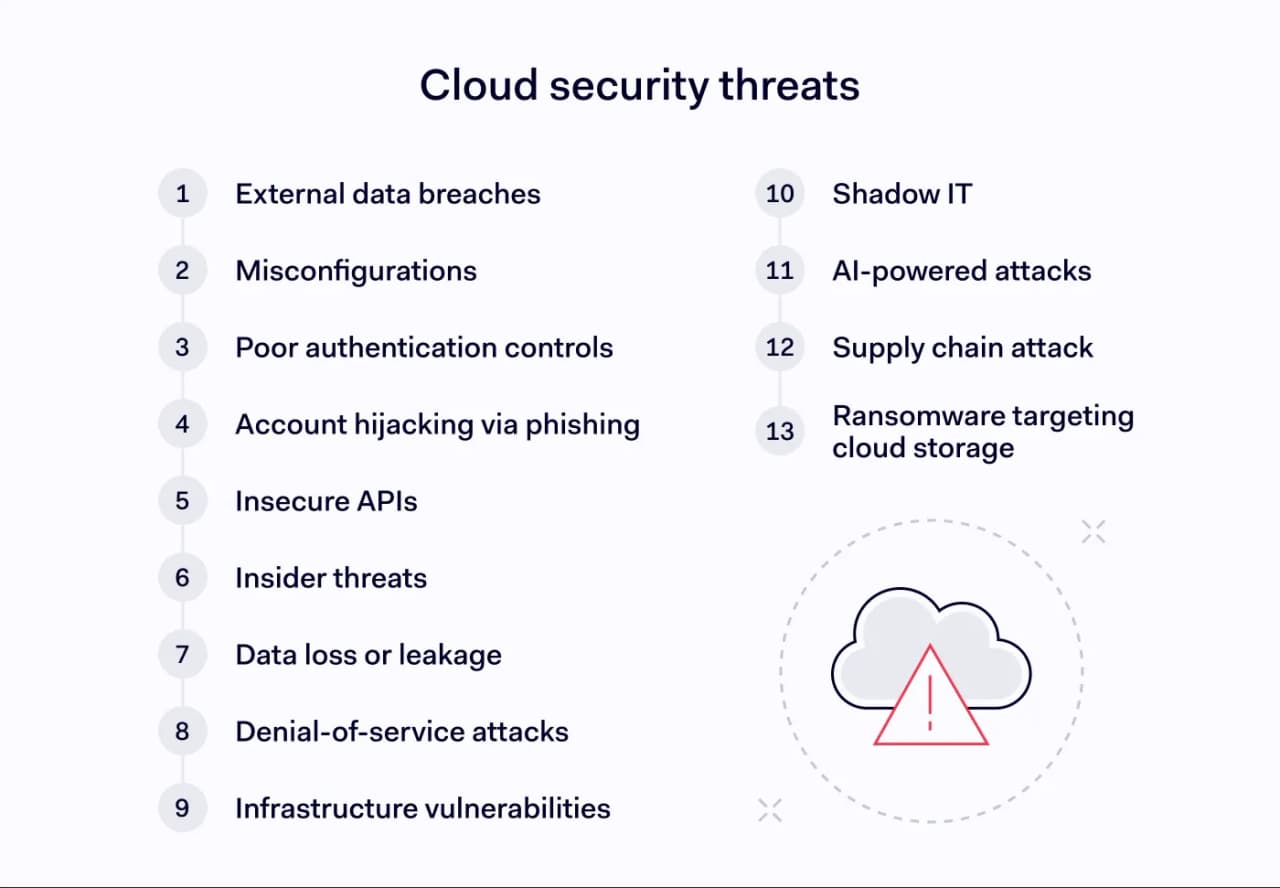
While the cloud is often safer than storing data on individual devices, no security system is free from risk. Cloud security threats include external data breaches, misconfigurations, poor authentication controls, phishing attacks, insecure APIs, insider threats, data loss, denial-of-service (DoS) attacks, shadow IT, AI-powered attacks, supply chain attacks, ransomware, and vulnerabilities within the infrastructure itself. Understanding cloud security risks early helps reduce the chance of data exposure, downtime, and long-term financial damage.
1. External data breaches
Data breaches remain one of the most serious cloud security risks because business data is often located in cloud databases, storage buckets, backups, SaaS apps, and collaboration tools.
Google Cloud reported that data was targeted in 73% of cloud-related incidents it analyzed. That’s why organizations should know where sensitive data is stored, who can access it, and when large downloads, unusual exports, or suspicious access attempts happen.
2. Misconfigurations
Cloud infrastructure is very complex, so there’s a real risk of missing something when setting it up. Organizations risk misconfiguring their access systems when scaling up or scaling down their operations. Missing important updates or overlooking existing infrastructure shortcomings may also contribute to critical misconfigurations.
Misconfigurations are a common entry point for advanced persistent threats, allowing attackers to move undetected through a system. Examples include publicly exposed storage buckets, overly permissive roles, and forgotten test environments left open to the internet. Regular security assessments, automated configuration checks, and cloud security posture management (CSPM) tools can help reduce these risks significantly. Staying on top of these cloud security risks requires continuous education and robust monitoring.
3. Poor authentication controls
Your data is as secure as strong is the weakest component within its chain. If the only thing that your employees need is a username and a password, this is something that could be easily exploited. Generally, the rule is to protect sensitive assets with a corresponding level of authentication mechanisms. The more sensitive the data, the more authentication layers it should have.
Multi-factor authentication (MFA), single sign-on (SSO), and role-based access control (RBAC) should be considered standard. Organizations should also review and update user access regularly to ensure that only those who need access have it. Educating users on strong password hygiene further reduces the likelihood of compromise.
4. Account hijacking via phishing
Hackers don’t need to penetrate your internal networks when the data is hosted in the cloud. This means that hijacking your administrator’s account and posing as one could be enough to gain direct access to the cloud-hosted data. It requires less effort to pull off than bypassing various cybersecurity defenses that could be deployed internally.
Phishing attacks often use social engineering tactics to trick users into clicking malicious links or entering credentials on fake login pages. To protect against this, businesses should train employees to recognize phishing attempts and use email filtering tools that block suspicious messages. Monitoring for abnormal login behavior can also help detect compromised accounts early. This type of cloud security threat is often used as the first step in launching more dangerous attacks, such as advanced persistent threats.
5. Insecure APIs
Growing Application Programming Interface (API) usage creates more ways for cloud services, applications, and users to exchange data. An API is a connection point that lets one system request information or trigger an action in another system. If an API has weak authentication, poor authorization, exposed keys, or insecure code, hackers may use it to access, change, or extract data.
Insecure APIs can act as direct entry points into cloud systems. API keys should be stored securely, and all API requests should require proper authentication. Organizations should also limit what each API can do, test APIs for security issues, monitor unusual traffic, and use API gateways to control access.
6. Insider threats
Even if external hackers are kept at bay, rogue or malicious insiders pose a real risk if they have access to sensitive data and systems. Insider threats can come from employees or third-party contractors and involve data theft, sabotage, fraud, and more. Strong access controls and monitoring are needed to mitigate this threat.
Sometimes, insider threats are unintentional, such as an employee accidentally deleting critical data or misconfiguring a system. This makes it essential to follow the principle of least privilege and maintain detailed activity logs. Encouraging a culture of security awareness and enabling anonymous reporting can help detect suspicious behavior early.
7. Data loss or leakage
When data is moved to the cloud, there is a risk it may inadvertently be shared too broadly if access policies are misconfigured. Even accidental deletion poses a risk if proper backups are not in place. Strict classification and access policies are needed to prevent unauthorized data exposure.
Regular backups, ideally stored across different geographic locations, are vital to ensure quick recovery in the event of loss. Organizations should implement data loss prevention (DLP) tools to monitor and restrict the movement of sensitive information. Encrypting backups and using retention policies also adds a layer of protection.
8. Denial of service attacks
As cloud infrastructure relies on constant online connectivity, it is susceptible to DDoS attacks which attempt to overload servers and resources with traffic. Protection against these threats requires strategies like traffic filtering, mitigation services, and redundancies.
Modern DDoS attacks can be multi-vector, targeting different layers of the network stack simultaneously. Partnering with a cloud provider that includes built-in DDoS protection and auto-scaling features helps ensure service continuity. It's also wise to have an incident response plan specifically for DoS scenarios. When left unchecked, these cloud security threats can cause severe downtime, loss of customer trust, and financial loss.
9. Infrastructure vulnerabilities
Despite best efforts, newly discovered software or hardware vulnerabilities may still affect cloud platforms. Providers need responsive processes to patch flaws, and customers need diligence in applying updates. Continuous monitoring assists with rapidly identifying and fixing issues.
Organizations should stay informed about common vulnerabilities and exposures (CVEs) and subscribe to vendor alerts. Vulnerability scanning tools can help identify potential weak spots, while automated patch management can reduce the window of exposure. Collaboration with providers is key for coordinated and timely mitigation.
10. Shadow IT
Shadow IT refers to the use of unauthorized cloud services or applications within an organization. Employees might use third-party tools or storage platforms without IT approval, often in an attempt to improve productivity or convenience.
These unmonitored tools often lack proper security controls and can create significant data security risks, especially if sensitive information is uploaded. Organizations should implement policies that define acceptable tool usage, monitor for unknown services in network traffic, and educate users about the dangers of unsanctioned cloud tools.
11. AI-powered attacks
AI-powered attacks use artificial intelligence to make cyberattacks faster, more convincing, or easier to scale. For example, hackers can use AI to write realistic phishing emails, create fake support chats, clone voices, generate fake identity documents, or automate parts of an attack. That’s important because many cloud breaches begin with identity abuse, such as tricking an employee into giving away credentials.
AI can also increase the risk of shadow AI, which means employees use unapproved AI tools for work. If they paste customer data, source code, credentials, or internal documents into these tools, sensitive information may leave the organization’s control. Businesses should set clear AI use rules, monitor unsanctioned tools, train employees to spot AI-assisted scams, and apply the same access controls to AI systems as they do to other business applications.
12. Supply chain attacks
Supply chain attacks happen when hackers target a trusted third party instead of attacking the main organization directly. In cloud environments, this third party may be a SaaS provider, managed service provider, software vendor, open-source package, CI/CD tool, or integration with access to cloud data. (CI/CD means continuous integration and continuous delivery, which are systems developers use to build, test, and release software.)
Supply chain attacks are dangerous because trusted tools often have broad permissions. A hacked vendor account, malicious software update, stolen OAuth token, or vulnerable open-source component can give hackers access to customer data or cloud systems.
13. Ransomware targeting cloud storage
Ransomware is malware that locks or encrypts data so the victim cannot use it. In cloud environments, ransomware attacks may also target storage buckets, databases, backups, snapshots, and virtual machines. Some hackers first steal cloud data and then threaten to publish it, which adds extortion pressure even when the organization has backups.
Cloud ransomware can be especially damaging when attackers delete backups or move from on-premises systems into cloud apps. To reduce the risk, organizations should isolate backups from regular administrator accounts, require extra approval for deleting backups or snapshots, monitor unusual data access, and test recovery plans. Backups should be encrypted, protected from deletion, and regularly tested so the business can restore data after an attack.
Cloud security vulnerabilities
Cloud vulnerabilities are a sensitive subject because cloud services are used for development, analytics, machine learning, and other tasks. There are multiple weak points that hackers will check first when attempting to penetrate a network. Here’s the list of the top cloud vulnerabilities.
Open S3 bucket
An Amazon S3 bucket is a cloud storage container used in Amazon Web Services. Similar storage services exist in other cloud platforms, such as Azure Blob Storage and Google Cloud Storage. These storage containers are useful for files, backups, logs, images, and application data, but they can become a serious vulnerability.
For example, in 2024, Football Australia confirmed that some data repositories were made publicly accessible because of a system misconfiguration. The exposed repositories included identity documents, financial information, and health information for some players and personnel. Also, in 2026, TechCrunch reported that money transfer app Duc exposed driver’s licenses, passports, and other personal data through a publicly accessible Amazon-hosted storage server.
Incomplete data deletion
One of the trickiest parts of cloud data management is data deletion. On the one hand, it’s a process that should be done irreversibly. On the other hand, an administrator must ensure that there are no backups left.
In cases when multiple tenants are sharing the infrastructure, data should be deleted without the possibility of retrieving it. It’s not enough to wipe the hard drive and hope for the best. Cloud data deletion should follow the provider’s deletion, retention, versioning, and backup procedures. For sensitive data, organizations should use encryption, key management, lifecycle rules, and documented sanitization controls.
As for the data backups, this requires full visibility of where they are kept. There shouldn’t be any unsupervised copies lying in the cloud as, over time, this data could find its way to hackers. That said, in most cases, data deletion must follow the cloud provider’s procedures, so it will likely be a joint effort. Although some cloud service providers may have different requirements.
Lambda command injection
Lambda function is an AWS computing service that allows running code without provisioning or managing servers. It can execute code when needed, ranging from a few daily requests to thousands per second. The service model allows using this tool per the computed time only. It’s a convenient tool that tests any application or backend service.
Lambda functions can be vulnerable to command injection if they process untrusted event data and pass it into operating system commands without validation. Serverless functions should validate input, avoid unsafe shell execution, and run with least-privilege permissions.
As the user function is serverless, this greatly increases the potential attack surface. The function can be launched from various events like database changes, code modifications, notifications, and other events. This means that a hacker can try to inject an unexpected event into the vulnerable function, which is then passed down to the OS-level application. It’s potentially devastating to the stored data as the hacker could obtain direct access to the cloud using this vulnerability.
Failure of separation among multiple tenants
The multitenancy model helps drive costs low — multiple customers are using the same software instance, which is installed on multiple servers. User data and resources are located in the same computing cloud, controlled and distinguished by various unique identifiers. Naturally, the risks associated with this model arise from the shared model itself, as the used computer hardware is the same for multiple clients.
Data isolation is paramount in such scenarios as multitenancy would, by definition, be one of the best attack vectors at a hacker’s disposal. In multitenant cloud systems, tenants share some infrastructure but should be separated through identity, application, compute, network, and storage controls. The risk appears when those isolation controls fail.
Server-Side Request Forgery (SSRF)
SSRF happens when a server-side application can be tricked into sending a request to an unintended location, such as an internal service or cloud metadata endpoint. For example, an attacker could craft requests that get the server to connect to internal systems and expose sensitive data which is then returned to the attacker. This can give an attacker insight into the cloud infrastructure setup and potentially access to other systems. Careful input validation is needed to prevent SSRF.
Lateral movement
Once a bad actor has gained any level of access to a cloud system, they may be able to move laterally or “hop” from one instance or service to another to expand their reach. With privileges, they could access compute resources like containers or VMs, unauthorized systems with insecure configurations, backup instances for data extraction, and more. Compartmentalization and least privilege access models are key to containing lateral movement. Monitoring for anomalous account activity also helps.
How to prevent cloud security threats
Cloud security works best when prevention covers people, access, data, applications, and cloud settings at the same time. The goal is to reduce weak points before hackers can use them and limit damage if an incident happens.
- Use strong identity controls. Require multi-factor authentication, which means users must confirm their identity with more than a password. Use single sign-on to manage access from one place.
- Follow least privilege. Give users, apps, and service accounts only the access they need. Review permissions often and remove unused administrator accounts.
- Fix misconfigurations early. Use automated checks to find public storage, open databases, broad firewall rules, and risky cloud settings before hackers can exploit them.
- Patch cloud workloads. Keep virtual machines, containers, applications, APIs, and third-party tools updated.
- Protect sensitive data. Encrypt important data, restrict file sharing, and monitor unusual downloads or transfers.
- Monitor logs and prepare backups. Track sign-ins, administrator actions, API use, and configuration changes. Keep protected backups and test recovery plans for ransomware, data deletion, and hacked accounts.
Summary
While cloud computing is an incredible opportunity for most businesses to reorganize their infrastructure flexibly, this doesn’t come without a price. While, by default, cloud security provides much more safety than locally hosted data, there’s much that an organization should keep in consideration when setting it up.
Like most systems, cloud computing isn’t without its weak points. Misconfigurations and poor authentication controls are among the most common and serious cloud security weaknesses. It’s important to emphasize that cloud security isn’t given. The high status of security has to be maintained.
Then, there are quite many vulnerabilities that a hacker could exploit when planning an attack on your cloud. Network administrators should be in the loop about the latest developments regarding S3 bucket exploits and be very cautious regarding the deletion of backups and other data. Only by timely addressing various cloud risks can it be possible to create a secure model that helps businesses achieve their goals.